
How Difficult is Annapurna Circuit Trek For Beginners?
People searching for how difficult is the Annapurna Circuit Trek usually get one of two answers: “it’s easy, anyone can do it” or “it’s brutal, only athletes should try.” Neither is accurate!
The trek sits in the moderate to challenging range, and its difficulty comes from a handful of specific, manageable factors rather than raw physical extremity.
This guide breaks down exactly what makes the route hard, why each factor catches beginners off guard, and what actually works to handle it!
Quick Answer: How Difficult is Annapurna Circuit Trek?
Most trekking agencies, including we at Everest Trekking Routes grade the Annapurna Circuit as moderate to strenuous.
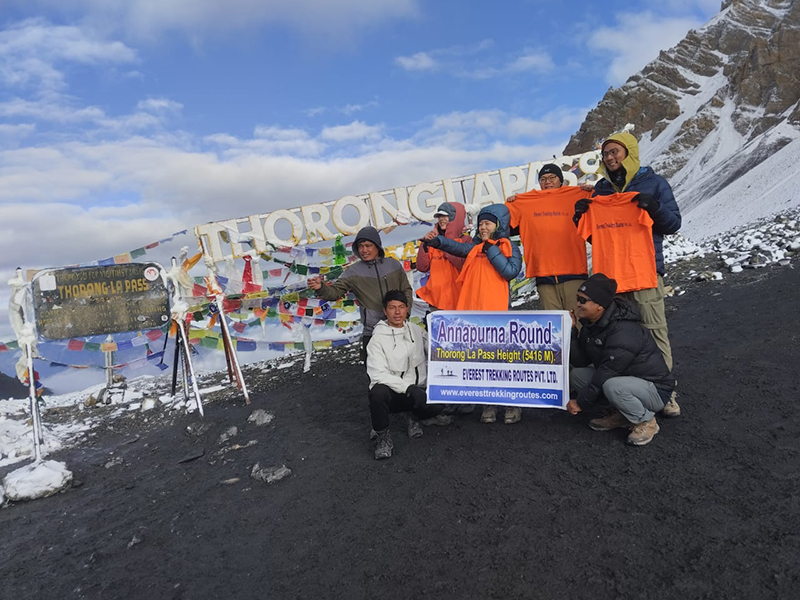
It is harder than short treks like Poon Hill, but easier than technical climbs requiring mountaineering skills. The route runs 160 to 230 km depending on your start and end points, with an elevation gain from around 760 m to 5,416 m at Thorong La.
The difficulty is not about climbing skill. It is about altitude, distance, and daily endurance stacking up over 12 to 18 days. Beginners with reasonable fitness usually finish it, but only if they respect the factors we are going to discuss next.
Difficulty Factor #1: Altitude and Thorong La Pass
This is the single biggest reason beginners struggle. Thorong La Pass sits at 5,416 m, and oxygen levels there drop to roughly 50 to 55 percent of what you breathe at sea level.
A 2022 survey published in Wilderness & Environmental Medicine, based on trekkers screened at the Manang Aid Post, found an acute mountain sickness incidence of 45 percent using one scoring threshold and 29 percent using a stricter one.
That means nearly half of trekkers experience some symptoms before even reaching the pass!
Beginners underestimate this because altitude sickness has nothing to do with fitness level. A strong runner can still get AMS while a slower hiker sails through, because the difference comes down to ascent rate, not leg strength.
The solution: Follow a “climb high, sleep low” itinerary with a built-in acclimatization day in Manang (3,540 m). Ascend no more than 300 to 500 m per day once above 3,000 m. Be sure to watch for headache, nausea, or disturbed sleep, and descend immediately if symptoms worsen instead of pushing through.
Difficulty Factor #2: Long Walking Days on Uneven Ground
Daily hiking on the Annapurna Circuit runs 5 to 8 hours, and the terrain shifts constantly. You will cross suspension bridges, loose scree, river crossings, and steep stone staircases, often within the same day.
Beginners who train only on flat ground or a treadmill often find their legs and ankles fatigued far faster than expected, because uneven trails recruit stabilizer muscles that flat walking never touches.
The solution: Train on actual hills or stairs for at least 6 to 8 weeks before departure. Practice with a loaded daypack so your body adjusts to real trekking weight, not just cardio fitness.
Difficulty Factor #3: Sudden Weather and Temperature Swings
The route crosses more than a dozen climate zones, from subtropical forest near Besisahar to the high-alpine desert around Muktinath.
Morning temperatures at High Camp can sit well below freezing, while afternoon sun at lower elevations feels warm enough for a t-shirt.
Beginners often pack for one climate and end up cold or overheated on the same day. Wind at Thorong La adds another layer of difficulty, which is why most groups cross before 8 a.m.
The solution: Pack in true layers, a base layer, insulating layer, and windproof shell, rather than one heavy jacket. Start pass-crossing days early, before wind speed picks up in the late morning.
Difficulty Factor #4: Basic Teahouse Conditions
Above Manang, facilities get simpler. Hot showers become rare or cost extra, rooms have no heating beyond a communal dining stove, and menus shrink to a handful of carb-heavy dishes.
For beginners used to hotel comfort, this limited recovery environment adds to the perceived difficulty, because rest quality drops right when the body needs it most.
The solution: Bring a warm sleeping bag rated for at least -10°C, a headlamp, and earplugs.Eat a good dinner, food fuels the climb the next day, skip alcohol above 3,000m, alcohol worsens dehydration and sleep quality.
Difficulty Factor #5: The Mental Load of Multi-Day Trekking
Physical fatigue is only half the challenge. Repeating the same routine, walk, eat, sleep, walk again, for 12 or more days wears on motivation, especially once the “new adventure” feeling fades around day 5 or 6.
Beginners rarely plan for this. The mental fatigue of a long trek often shows up more than the physical kind by the second week.
The solution: Break the trek into small daily goals rather than thinking about the whole distance at once. Rest days are not wasted time, they protect both your lungs and your motivation.
The Sections Beginners Struggle With Most
Based on where trekkers most often report exhaustion, cold injuries, or turning back, three sections stand out:
- Thorong Phedi to Thorong La: The final push gains roughly 1,000 m in a single morning, in thin air, often in freezing wind. This is consistently the hardest single day of the standard circuit.
- The descent into Muktinath: After the pass, trekkers drop about 1,600 m over 8 to 10 km of steep, rocky trail. Tired legs and loose footing make knee strain common here.
- Optional high-altitude add-ons: Trekkers who extend their trip with the Annapurna Circuit with Tilicho Lake Trek face an additional climb to 4,919 m, one of the highest lakes in the world, before rejoining the main route. The standalone Tilicho Lake Trek involves a short landslide-prone stretch near the base camp that demands careful timing. Similarly, a Nar Phu Valley Side Trip adds the 5,320 m Kang La Pass and more remote, basic infrastructure. These extensions are rewarding, but they are noticeably harder than the standard circuit and suit trekkers who already feel comfortable at altitude.
Practical Tips to Tackle the Difficulty
A few concrete habits make the biggest difference on the trail. Here are some tips for you:
-
Drink 3 to 4 liters of water daily above 3,000 m, since dehydration mimics and worsens AMS symptoms.
-
Add one buffer day into your itinerary near Manang. If you feel fine, use it for a short acclimatization walk; if not, it becomes a safety cushion.
-
Walk at a pace where you can hold a conversation. If you are gasping, you are moving too fast for your acclimatization stage.
-
Carry Diamox only after discussing it with a doctor before departure, not as a trailside decision.
-
Test your boots and pack on a multi-day practice hike beforehand. Blisters and pack soreness show up fastest in week one.
How We Help You Manage Difficulty?
For the standard Annapurna Circuit Trek, you need the Annapurna Conservation Area Permit (ACAP), along with a TIMS card. Our team at Everest Trekking Routes handles this paperwork directly as part of your package, so you are not tracking down offices in Kathmandu on your own schedule.
We also build acclimatization days into every itinerary before Thorong La, and we recommend a licensed guide as part of the package for route knowledge, pacing, and support if symptoms appear. This is a safety choice we build into our service, not a requirement we are imposing!
So, if you are considering Annapurna Circuit or even extending this trip with Nar Phu Valley or Tilicho Lake, reach out and we will structure the extra days around your fitness level and travel dates.


Recent Travel Blog
Travel tips and Mostpopular activities around in Himalayas.

Manaslu Circuit Trek: Remote Himalayan Adventure via Larke Pass
The Manaslu Circuit Trek begins with a road that slowly stops being a road. Past Arughat, the pavement turns to dust, then gravel, then a jeep track squeezed against the…

Manaslu Circuit Trail Nepal: Route, Teahouses, and Tips
The Manaslu Circuit Trail is one of the very few long Himalayan routes that still feels like a working mountain path! It starts in warm valleys near Soti Khola and…

Guided Annapurna Circuit Trek: Costs, Permits & Local Advice
Anyone researching a guide for the Annapurna Circuit Trek usually lands on the same question. Is it actually necessary, or is it just something agencies push to sell packages? We…